QSR Back of House Technology: What UK Restaurant Groups Actually Use
By Johanna · · Updated
QSR back of house technology – the combination of kitchen display systems, integrated restaurant POS software, and order routing tools – has become one of the most consequential operational investments a UK restaurant group can make. At low volume, an order error costs a few minutes. At the scale most QSR groups operate, errors and delays compound into lost revenue, longer wait times, and the kind of staff pressure that drives turnover. The UK quick service restaurant market was valued at roughly £23 billion in 2025, with close to 50,000 businesses in operation (Statista). Winning in that market is not purely a front-of-house problem. It starts in the kitchen – in how orders flow from every channel to the right station at the right time. This article covers what back-of-house technology actually encompasses for UK QSR operators, why the commercial case for it has sharpened significantly in 2025 and 2026, and what good looks like when you are evaluating options.
TL;DR: QSR back of house technology refers to the systems that route, display, and track kitchen orders – primarily kitchen display systems, integrated POS software, and delivery channel managers. For UK operators, the case for investment is driven mainly by rising labour costs and the operational cost of managing multiple delivery platforms manually. The operators seeing the most measurable results are those who have unified their ordering channels, POS, and kitchen display into a single connected system rather than patching tools together after the fact.
What does QSR back of house technology actually cover?
“Back of house technology” is used loosely. In a QSR context, it refers to three interconnected layers.
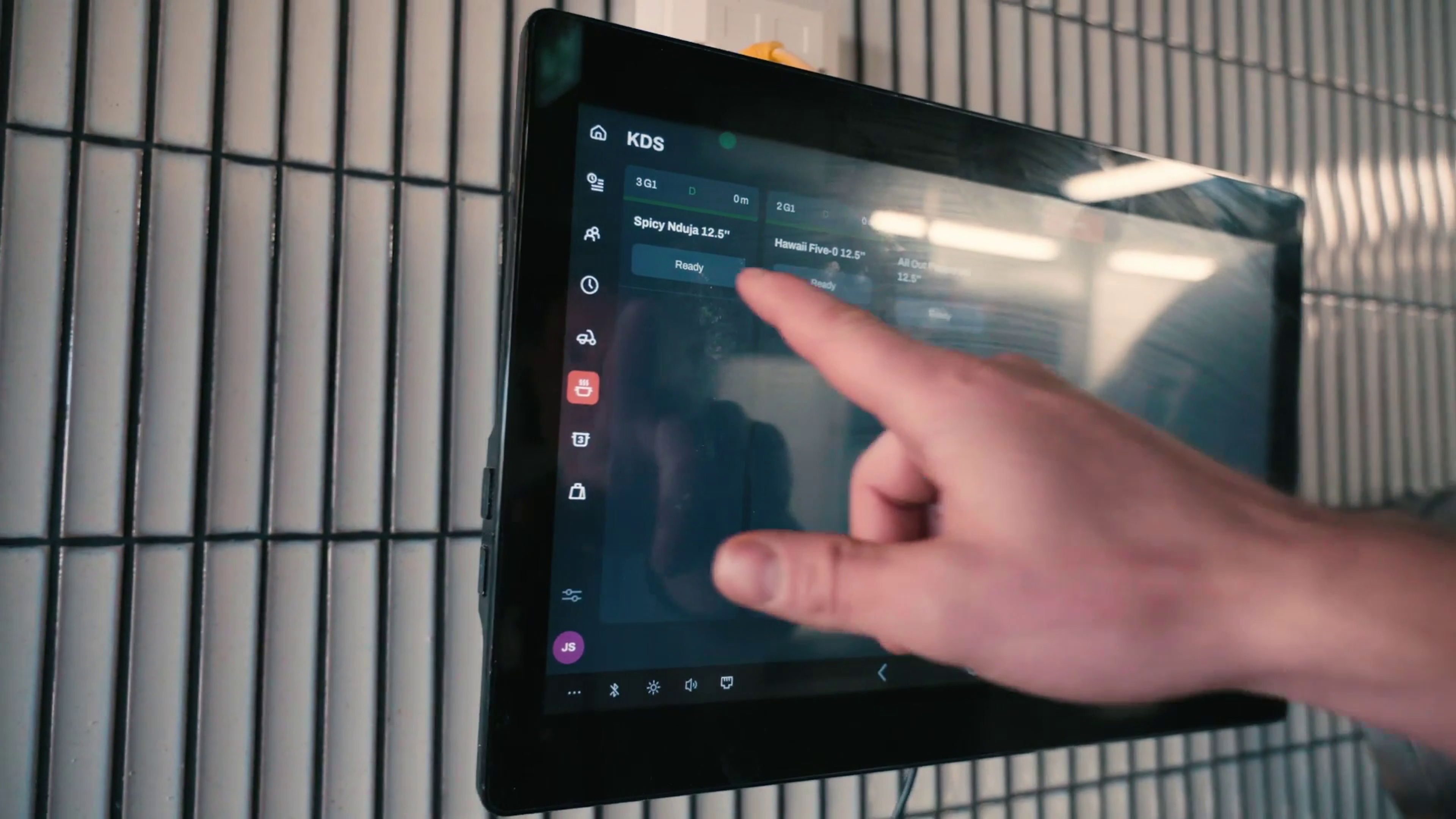
The first is order routing and display: how orders from every channel – in-house POS, kiosks, branded app, website, and third-party platforms including Just Eat, Deliveroo, and Uber Eats – travel from the point of entry to the relevant kitchen station. Kitchen display systems sit at the centre of this layer, replacing printed tickets with real-time digital screens that staff can acknowledge, prioritise, and mark complete.
The second is production management: the tools that sequence orders based on prep time, group items for delivery runs, and track ticket times. At basic implementation this means a single KDS screen showing all open orders. At more advanced implementation, orders are split by station (grill, fryer, cold drinks, desserts), displayed only when they need to start, and colour-coded to signal urgency.
The third is reporting and visibility: the operational data that flows back from the kitchen to the ops hub. How many orders were completed in under five minutes? Which station is creating the most bottlenecks? What does throughput look like on a Friday versus a Tuesday? That data provided by restaurant analytics software becomes the basis for scheduling decisions, menu changes, and site comparisons across a group.
The distinction that matters when evaluating options is whether these three layers live in a single native platform or are patched together through integrations. A kitchen display system that sits natively within the same system as the POS, channel manager, and reporting suite behaves differently to a standalone KDS bolted onto a third-party POS. When a product is 86’d at the POS, a native system updates the kitchen view and every delivery platform simultaneously. A patched system frequently does not.
Why are UK QSR operators prioritising back-of-house investment right now?
The timing of back-of-house technology investment is not coincidental. UK hospitality labour costs typically run at 30–35% of revenue (UKHospitality, 2025), and that proportion has been under pressure from two directions at once.
The National Living Wage rose to £12.21 per hour from April 2025 and will rise again to £12.71 from April 2026. UKHospitality estimates that wave of increases will add around £1.4 billion in additional wage costs across the hospitality sector. Alongside the wage changes, employer National Insurance contributions rose from 13.8% to 15% from 6 April 2025, with the secondary threshold cut from £9,100 to £5,000. UKHospitality described the combined NIC impact as adding “at least £2,500 per full-time employee” – a significant hit for high-headcount QSR operations running on thin margins.
Labour is the primary cost technology is being asked to protect. When a restaurant group has orders arriving from three delivery platforms, a kiosk, and a counter simultaneously, the old answer was to hire someone to manage the chaos. The practical answer is to build a system that removes the chaos.
Delivery commission is a separate pressure. UK platform rates run at roughly 14% for Just Eat self-delivery, up to 30% for Uber Eats full-service (plus a one-off £650 activation fee), and 25–35% for Deliveroo, which was acquired by DoorDash in October 2025. VAT applied to those commissions pushes the effective deduction on full-service orders to around 36% of the order value. At those margins, any inefficiency driven by manual re-keying or missed orders costs considerably more than the technology required to prevent it.
Square’s Future of Commerce 2025 (February 2025) found that 85% of UK restaurant leaders planned to invest in technology including AI and automation. A CGA by NIQ and Fourth Business Confidence Survey found that 42% of UK hospitality leaders already have a digital solution to help retain staff, with a further 31% planning to invest in one. The investment case has shifted from operational preference to operational necessity.
What do kitchen display systems do for high-volume UK kitchens?
A kitchen display system routes orders from the POS or third-party platforms directly to a screen at the relevant kitchen station, where staff can see every live order, acknowledge items, and mark them complete. The alternative – a printer producing paper tickets – creates the conditions for orders to be lost in service, for parallel preparation to break down, and for managers to have no real-time visibility on what the kitchen is doing.
KFC UK & Ireland deployed QSR Automations’ ConnectSmart Kitchen across 900+ stores and confirmed a reduction in order errors following the rollout. The company did not publish a specific percentage, but CTO Brad Scheiner noted that “ConnectSmart Kitchen has become an integral part of our kitchen operations. We have seen reduced order errors since the pilot.” YO! Sushi reported a 10% increase in kitchen throughput and a labour reduction equivalent to one full-time employee per site after implementing Vita Mojo’s kitchen display screens – both figures are vendor-published, not independently audited.
The gains operators report most consistently are: no missed orders because a ticket fell behind the counter, reduced prep times because orders display only when they need to start, and increased kitchen capacity because parallel preparation across stations replaces sequential working.
Peter, Head of Operations at Fired Up Pizza, describes in the video below how the business moved from running deliveries one by one – a labour-heavy process where “wage cost were through the roof” – to using the Boss It waiting room and KDS to group delivery orders together, colour-code them by run, and coordinate packing in sequence. The result was a material reduction in delivery labour and an improvement in accuracy that their previous setup could not achieve.
Boss It operators using the KDS have reduced order prep time by 40%, with several sites reporting that this has nearly doubled kitchen capacity during peak service.
How does quick service restaurant POS software connect front and back of house?
The POS is where front and back of house meet. An order placed at the counter, via a kiosk, through a branded app, or from a delivery platform all need to reach the kitchen. How reliably and quickly they get there depends entirely on how the quick service restaurant POS software connects to the rest of the system.
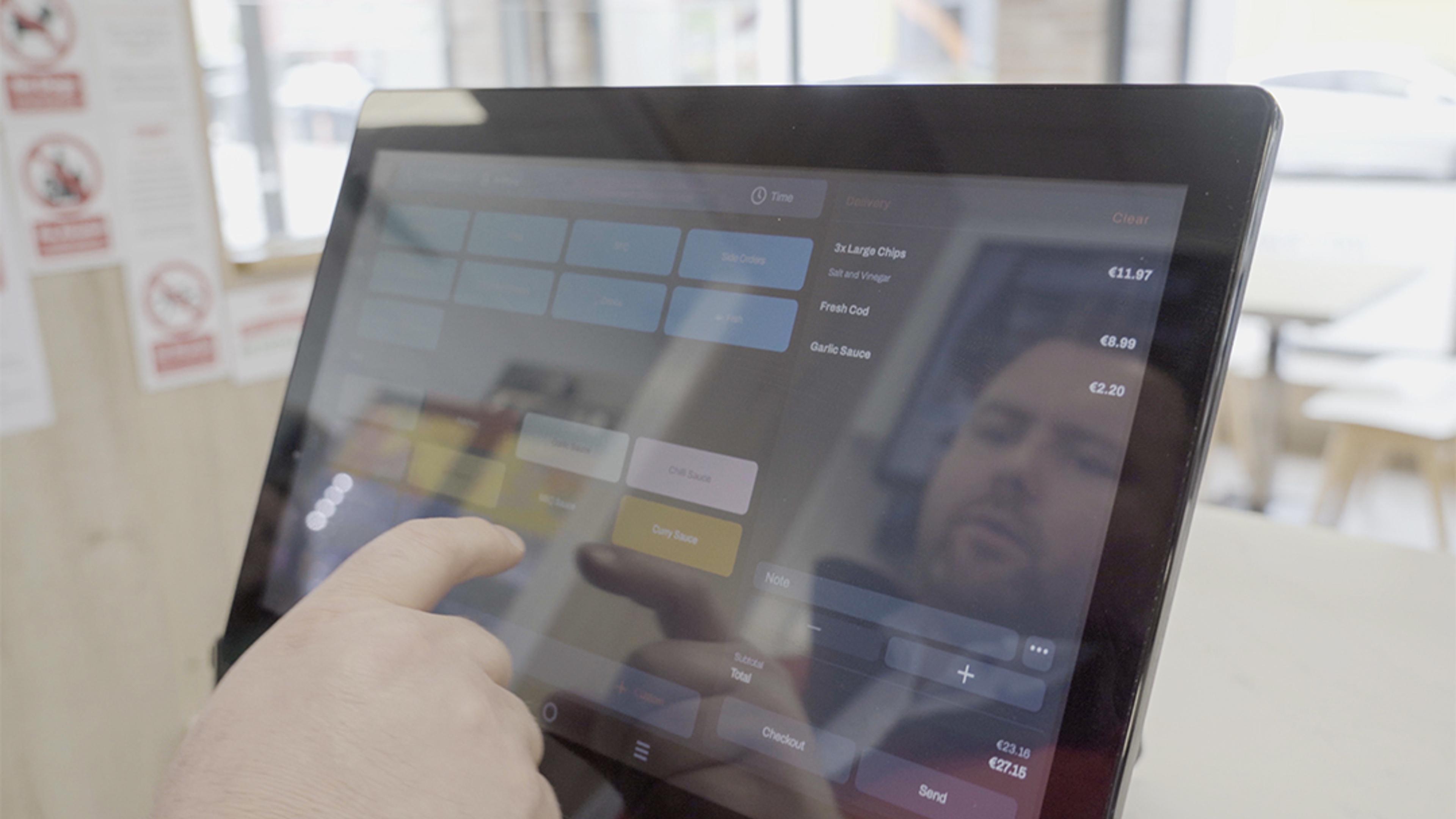
The most common failure point in multi-channel QSR operations is what the industry calls the “tablet graveyard” – one device per delivery platform sitting next to the till, each requiring a staff member to read an incoming order and manually re-key it into the POS. Errors occur at that transfer. Speed is lost. When a product runs out, the update needs to be made separately on each platform.
A channel manager built into the POS resolves this by consolidating orders from Just Eat, Deliveroo, Uber Eats, and direct channels into a single screen. Chopstix, the UK’s largest pan-Asian QSR chain with over 100 stores, eliminated this problem via a delivery middleware integration and reported that rejected orders reduced by 88% to near zero, store availability reached 97% across three channels, and end-to-end delivery time reduced by more than 30%, with a 14% revenue uplift within two months of removing manual till entry (Deliverect case study).
Menu management becomes significantly simpler in a unified system. When a product is unavailable, one update at the POS propagates across every ordering channel in real time – no duplicate effort, no live items on Uber Eats that the kitchen can no longer fulfil. Workload management is a further POS-driven back-of-house tool: the ability to adjust wait times for delivery or collection during peak periods, communicate accurate expectations to customers, and reduce the complaint volume that builds when a kitchen is overwhelmed and customers are told nothing.
What should UK QSR groups look for when evaluating restaurant kitchen automation?
Restaurant kitchen automation covers a broad range in 2025, from integrated KDS and order routing at the operational end to physical robotics at the other. For most UK QSR groups with multiple sites, the relevant automation is digital: systems that remove human decision-making from order routing, ticket sequencing, and stock-depletion workflows.
Nando’s ran a 30-day trial of Karakuri’s FRYR210 automated fry line at its Park Royal, London site, rated at up to 550 portions of chips per hour. The trial was significant but also illustrative of where physical kitchen robotics sits for most operators: still at pilot stage, with hardware cost, maintenance complexity, and menu flexibility remaining material barriers. For the majority of QSR groups, the practical automation layer in 2025 is software.
The evaluation checklist for back-of-house technology has five practical criteria. Native integration comes first: does the KDS sit in the same platform as the POS, channel manager, and reporting, or is it a standalone tool requiring its own integration layer? Station-level routing comes second: can orders be split by type so each part of the kitchen sees only what it needs to prepare? Real-time menu sync is third: when a product is paused at the POS, does it update every channel instantly? Reporting depth is fourth: does the system capture ticket times and throughput data in a format that can be compared across sites?
The fifth consideration – often underweighted at evaluation stage – is whether the platform supports a meaningful agentic AI layer. Boss It’s AI allows owners, managers, and staff to take operational actions by prompting the system directly in any language: pausing products, adjusting staffing levels, pulling live sales data. As this capability expands to stock ordering and staffing predictions, it will become a meaningful differentiator between platforms.
Key takeaways
UK QSR back-of-house technology investment is now driven by arithmetic rather than aspiration. A 30–35% labour cost base, mandatory wage increases reaching £12.71/hour from April 2026, a £2,500+ per employee NIC hit, and delivery commission rates around 36% on full-service orders leave almost no margin for operational waste. The operators who have moved on unified KDS, POS, and channel management are reporting material gains in throughput, accuracy, and revenue.
The single most important decision in a back-of-house technology evaluation is whether to buy native or integrate. A platform where POS, KDS, ordering channels, and reporting all function within the same system removes the failure points that patched tools introduce. The secondary decision is reporting depth: a KDS that does not feed ticket-time data into a multi-site comparison view solves a kitchen problem but not an operations problem.
UK operators with three or more sites are past the point where this is a capital investment question. Running high-volume service on paper tickets and manual re-keying in 2025 is not a budget decision – it is a competitive disadvantage.
Frequently asked questions
What is QSR back of house technology?
QSR back of house technology refers to the systems that manage kitchen operations – primarily kitchen display systems, integrated POS software, delivery channel managers, and stock control tools. These systems route orders from every channel to the correct kitchen station, track preparation in real time, and feed operational data back to a central reporting hub.
What are kitchen display systems and how do they work in UK restaurants?
A kitchen display system replaces printed paper tickets with a digital screen at each kitchen station. Orders are sent directly from the POS or delivery platforms to the relevant screen, where staff acknowledge, prioritise, and mark items complete. Screens can be split by station type – hot food, cold drinks, desserts – so each part of the kitchen sees only the work it needs to prepare.
How does quick service restaurant POS software reduce kitchen errors?
By eliminating manual re-keying. When all order channels feed directly into the POS and on to the KDS, staff do not transcribe orders from a delivery tablet to the till. Chopstix reported an 88% reduction in rejected delivery orders after removing manual entry from their order flow.
How does back-of-house technology help with rising UK labour costs?
It reduces the headcount required to manage order routing, delivery coordination, and kitchen communication. With employer NICs rising from April 2025 and the National Living Wage reaching £12.71 from April 2026, automating the manual steps in kitchen operations directly reduces the labour hours required per order and per shift.
What should a multi-site QSR group look for in a kitchen display system?
Native integration with the POS and delivery channels, station-level order routing, real-time menu syncing, and multi-site reporting on ticket times and throughput. Standalone KDS tools that require separate integrations tend to reintroduce the same failure points they are meant to eliminate.
Is restaurant kitchen automation suitable for most UK QSR operators right now?
Physical robotics such as automated fryers are still at trial stage in the UK – Nando’s ran a Karakuri pilot at one London site. For most operators, the practical automation layer in 2025 is digital: unified KDS, channel management, and AI-assisted operations within a single connected platform.
How does Boss It’s platform support QSR back-of-house operations?
Boss It provides a fully native KDS, POS, channel manager, stock control, and reporting suite within one platform. Operators using Boss It’s KDS have reduced order prep time by 40%. To see how it works in practice, visit bossithq.com.